

For centuries there has been a mill on the site where Clymping Mill now stands. Records dating as far back as the Middle Ages suggest that there was once a settlement here.
It has been mentioned that the whole area of Clymping was a favourite haunt with smugglers from the birth of the practice in the 13th and 14th Centuries, following the advent of trade tariffs – the site being hidden from the prying eyes is equidistant from Bognor Regis and Littlehampton and for many years had very scant access, other than an old dirt track.

It is believed that a windmill has stood on this site since 1378. Mariners would use the high sails of the Mill to navigate their way into safe harbour during high storms.
Originally known as Atherington Mill after Atherington Manor, around 1485, it became known locally as Tottisham or Totsham Grain Mill. During the 1780s it was mostly referred to as Clymping Mill, off Bread Lane. The present octagonal, weather-boarded Mill, rebuilt in 1799, is an early example of a Smock Mill.
In the 19th Century the Barnard family owned the Mill for many years. The internal machinery was replaced with a steam engine to supplement wind power; at this point Clymping Mill was one of only two steam Mills in the world… it is assumed that it wasn’t too successful as a steam Mill… by 1895 it had ceased working forever.

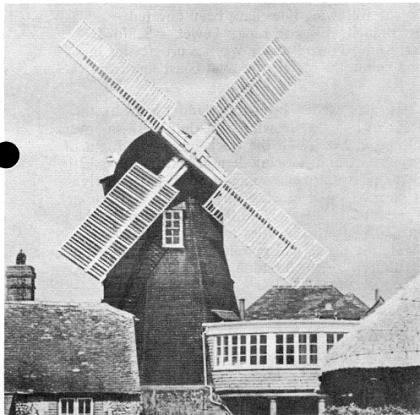
By 1914 it had become cottages, and in the 1920s it was converted into a single dwelling by a Lord Richard Garton with the addition of dummy sails.


In 1957 the complete internal workings of the Mill were taken out and destroyed all apart from the wind-shaft (axle), which is now allegedly stored at the British Museum.
Around 1960 the top two storeys of the Mill were completely removed; it had become ‘devastatingly’ infested with Death-watch Beetle and was therefore torn down and transformed into ancillary accommodation.
The site has had many incarnations in the last 100 years; not least a hospital for First World War veterans, then Christ’s Hospital’s school for boys, a language college, and in more recent years, multiple rented accommodations.

Above is shown an Ordnance Survey map of the Climping area from 1813 showing the location of “Climping Mill”.
 Clymping Mill